
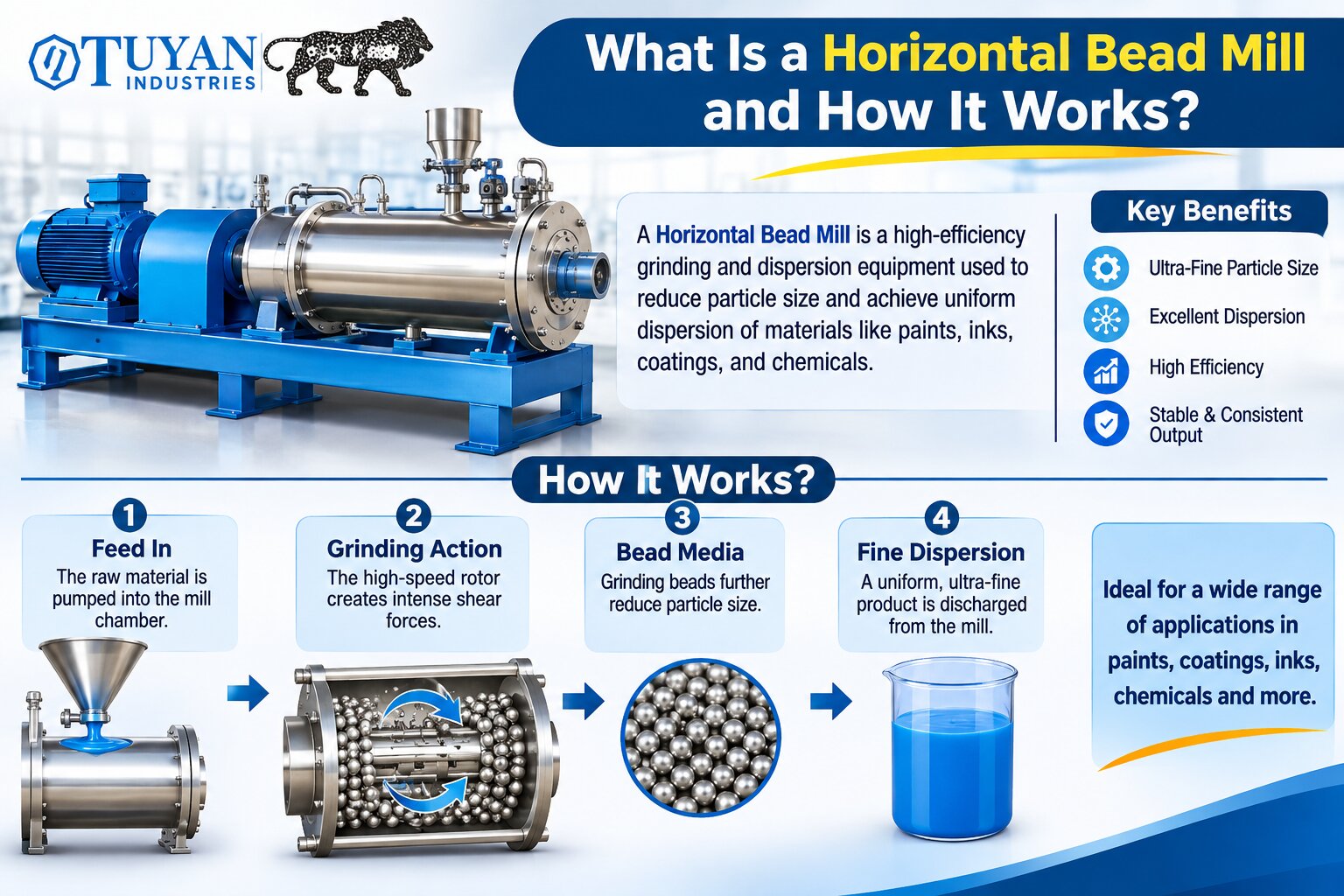
Have you wondered how the smoothness of paints on your wall is achieved? Or the consistency in the pen of your ink? Fine grinding of solid particles in a wet slurry needs a specialized machining process. These fine-ground pigments and inks are used in the paints, pharmaceuticals and textile industries. And the machine they use for this purpose is a horizontal bead mill. It is the machine behind your smooth paints and inks. There are many industries that use this mill for fine grinding of liquid slurry.
Understanding a Horizontal Bead Mill
A horizontal bead mill is a wet grinding machine that grinds solid particles with sizes close to the micron or even nano scale. It consists of a cylindrical grinding chamber filled with grinding beads, and its axis is horizontal. Grinding beads are cylindrical or spherical in shape and are used to crush the particles into finer sizes. The high-speed motion of the beads breaks down the particles suspended in the slurry. The flat chamber allows easy filling and cleaning. This is why it is preferred for continuous and large-scale production in painting, textiles, pharmaceuticals and other industries.
How Does a Horizontal Bead Mill Function?
The machine is big but its working relatively simply. The beads crush the particles, disintegrate them and the other processes support the complete work.
Premix Material Feeding
With a pumping mechanism, the premixed material is fed into the chamber. It contains a mix of liquid slurry and solid particles. The chamber has beads in proportion to the slurry.
Beads Grinding
Through a rotating agitator spinning on the horizontal axis, the beads move at a high speed. The particles break down into smaller sizes with impact pressure created by the beads.
Cooling
The process of grinding has ended but the machine needs to be cooled down as there is a high amount of heat that can damage the components. A cooling jacket is installed around the chamber to bring the temperature down. This is also important for materials, as they are temperature sensitive.
Discharge
A separator leaves the beads in the chamber and discharges the finished liquid as the output.
Key Components
There are essential elements of a bead mill which are listed below:
Grinding chamber: It is the chamber where milling occurs.
Agitator: The spinning shaft that generates motion within the beads.
Grinding beads: Small balls made of glass, zirconium oxide or steel.
Separator: Keeps beads inside while allowing the product to exit.
Mechanical seal: Prevents spillage of materials from the rotating shaft.
Cooling jacket: Regulates the temperature of the milling process.
Advantages of a Horizontal Bead Mill
Uniformity of the Particles
The machine provides a narrow distribution of particle size with an improvement in colour intensity, stability and quality.
High Bead Filling and Efficiency
Horizontal structures have the capability of keeping a large bead load. The beads would not fall down under the influence of gravity, thus ensuring efficient and thorough grinding.
Convenience of Use
The ease of access to the chamber allows the process of cleaning or changing color/style much quicker.
Ideal for Continuous Working
Consistent feeding and discharging of the various stages of production allow continuous production of large amounts of products.
Common Applications
Horizontal Bead mills are utilized across various industries:
- Coating and paints
- Inks for printing
- Dyes and pigments
- Pharmacy products in nanosuspension form
- Agrochemicals
- Cosmetics and personal care products
- Electronic ceramics and batteries
Conclusion
Turning the coarse slurry into fine, homogenous particles of micro size is what is accomplished by the horizontal bead mill. It grinds and disperses the particles and enables convenient filling and emptying of the chamber. To pick the right machine, choose the right capacity to achieve best results for your process. You can get the horizontal bead mills at Tuyan Industries. Our professionals will guide you in purchasing the suitable option.